
Around 70 % of the yoga mats sold each year are made of plastic, roughly 25 million petroleum-based mats a year. The material a mat is made of decides its grip when you sweat, how long it lasts, and whether it disappears in five years or fragments for centuries. This is the comparison across PVC, EVA, NBR, TPE, natural rubber, cork and PU, with the trade-offs each one actually carries.
If you decide on natural rubber after comparing materials, check whether any yoga mat discounts are available on Eco Daily and review their conditions.
For years we have practised yoga on materials that take centuries to disappear.
Why PVC still dominates
Nearly half of all mats bought each year are PVC, and the reason is price. It is cheap, easy to print on and quick to produce, which is how a mat can cost fifteen euros.
The cost is deferred, not avoided. PVC needs phthalates and other plasticisers to stay flexible, and those additives are what make it extremely hard to recycle. It does not decompose so much as fragment over a period measured in centuries, releasing what was added to it along the way.

“For years we have practised yoga on materials that take centuries to disappear. It is a contradiction: we seek personal wellbeing on products that create permanent harm to the planet”, explains David Almazán, founder of oléyoga.
The other synthetics: EVA, NBR and TPE
All three are petroleum products and all three get sold as the responsible alternative to PVC. They are not the same as each other.
- EVA is a light, flexible foam. Partially recyclable, non-biodegradable, and it compresses faster than the others, which is why cheap mats go flat where you kneel.
- NBR is a synthetic nitrile rubber. Thick and durable, with a high environmental footprint and complex degradation. It belongs to gym mats more than yoga mats.
- TPE is a thermoplastic elastomer, marketed hard as the eco option. It contains no phthalates, which is a genuine improvement, and it is not biodegradable whatever the product page says.
That last correction matters because it is repeated everywhere, including by retailers who should know. TPE is a synthetic copolymer whose properties depend entirely on the blend each manufacturer chooses (Thermoplastic Elastomers, InTech), so “TPE” on a label tells you less than it appears to.
What natural rubber does differently
It comes from the sap of Hevea brasiliensis, tapped from a living tree without felling it. The raw material is renewable, and nothing is cut down to get it.
What reaches a mat is vulcanised rubber, heated with sulphur so the polymer chains cross-link and the material stops being sticky and becomes elastic. It is well understood chemistry with decades of literature behind it.
Two corrections we would rather make than let stand, because we have seen both on our own pages and on competitors':
- It is not compostable. Vulcanising is what makes it last, and it is also what stops it breaking down in a garden. It degrades over roughly five to ten years, in conditions a compost heap does not provide.
- It is not practically recyclable. No kerbside stream in Europe takes a yoga mat. Breaking down eventually is better than PVC; it is not the same as being recycled.
The comparison table
| Material | Common composition | Does it degrade? | Grip | Weight (4 mm) | Durability | Notes |
|---|---|---|---|---|---|---|
| PVC | Petroleum-derived plastic | No. Centuries | Moderate, drops sharply with sweat | ≈ 1.2 kg | High, 5+ years | Cheap and tough. Contains phthalates, and its production generates highly polluting waste |
| EVA | Ethylene vinyl acetate foam | No | Basic | ≈ 1.1 kg | Medium, 2 to 4 years | Very light. Compresses permanently where you kneel |
| NBR | Synthetic nitrile butadiene rubber | No | Moderate, good cushioning | ≈ 1.6 kg | High, 5+ years | Thick and resistant, with a high environmental footprint. More a gym mat than a yoga mat |
| TPE | Synthetic copolymer | No. Recyclable in theory | Good dry, poor wet | ≈ 1.3 kg | Medium, 2 to 4 years | No phthalates, which is a real gain over PVC. Not biodegradable despite the marketing |
| Natural rubber (100 %) | Latex from Hevea brasiliensis | Yes. Roughly 5 to 10 years | Excellent, holds furthest into the wet range | 1.8 to 2.5 kg | High, 3 to 5 years | Best grip and stability, and the heaviest option. Contains latex. Smells for the first weeks |
| Cork over a base | Cork surface on rubber, or sometimes on TPE or PVC | The cork does. The base may not | Very good, and it improves as you sweat | ≈ 1.6 kg | Medium, 2 to 4 years | Renewable and antimicrobial. The real sustainability is decided by the base, which is rarely stated |
| PU over natural rubber | Polyurethane top layer on a rubber base | The rubber does. The PU does not | The best when wet | ≈ 2.5 kg | Medium. The top layer wears first | Excellent technical performance and the shortest surface life of the group |
The weight column is the one nobody publishes and the one that predicts most. Density is what holds a mat to a hard floor and what keeps grip under pressure, so the mats that grip best are the mats that are heaviest. If you carry yours daily, that is a real trade rather than a detail.
Why a cork or jute mat is never only cork or jute
Cork comes from the bark of the cork oak, harvested without felling the tree. Jute is a plant fibre. Both are genuinely renewable, and neither can make a functional mat on its own. Cork alone is too hard and too brittle; jute is too thin and has no structural support.
So they need a flexible base underneath, and in many cases that base is PVC, EVA or TPE. The surface looks natural and the mat as a whole is not. If a cork mat does not say what its base is made of, that silence is the answer.

“If yoga seeks coherence between body, mind and environment, the surface we practise on should also reflect that philosophy”, Almazán says.
How grip actually behaves
Grip is not one property, and this is where most comparisons fall down. The friction between skin and a surface changes with moisture and it does not change in a straight line: a little damp can increase it, a continuous film separates the surfaces and collapses it. It is well studied ground (a review of skin tribology).
Which means a mat can be honestly excellent dry and poor wet, and “non-slip yoga mat” without saying which is close to meaningless. Rubber holds furthest into the wet range of the common materials. Cork runs the opposite curve, gripping better as it dampens until it saturates.
Nobody in this category publishes a grip number. Not a coefficient, not a test standard, not a method, ourselves included. Read every ranking above, this one too, as an argument rather than a measurement.
Where our mat sits, and where it does not
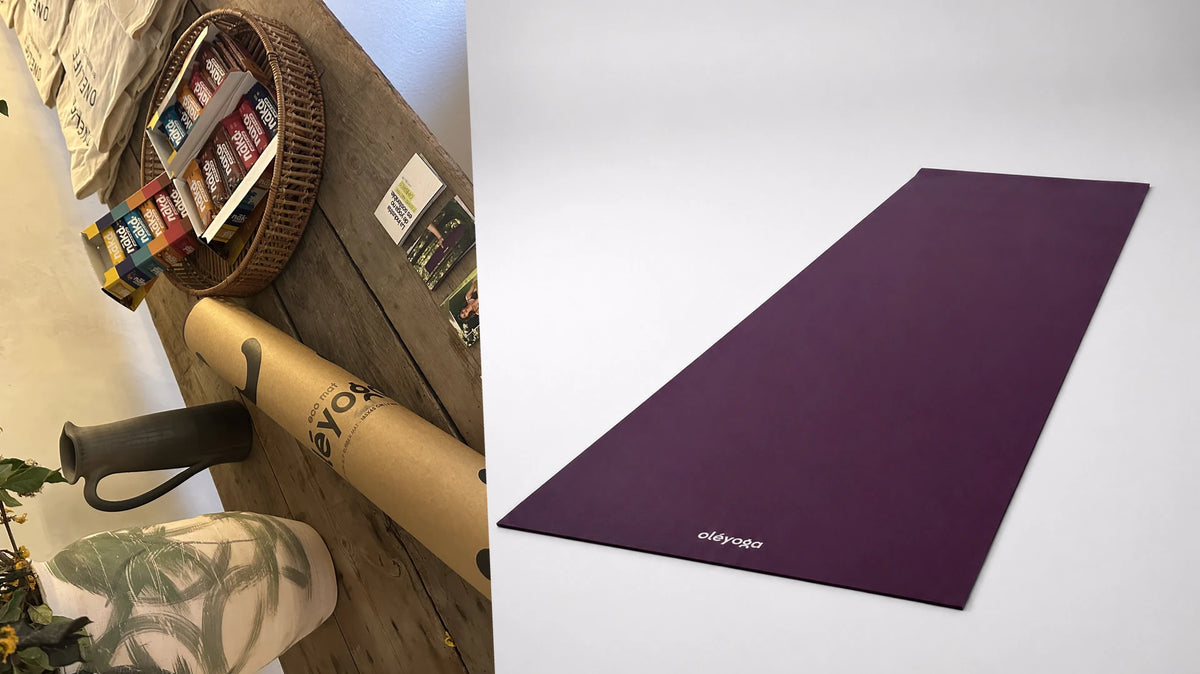
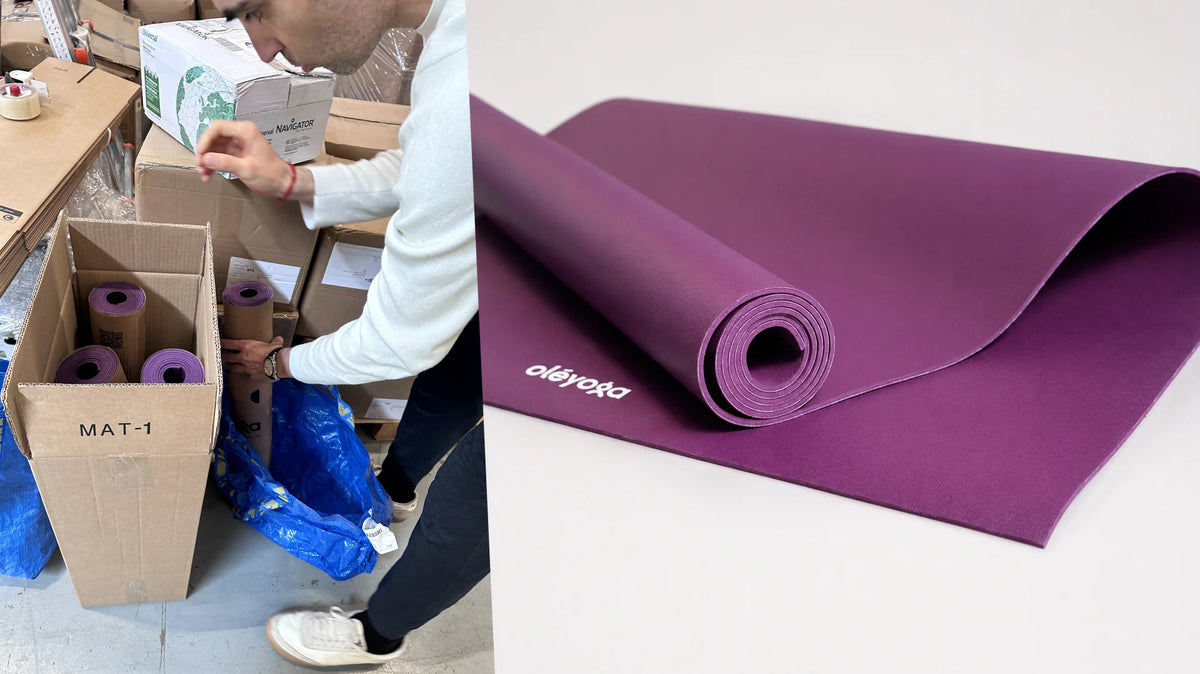
The Eco Daily is 4 mm of 100 % natural rubber, 185 × 65 cm, reversible, 1.8 kg, made in Europe. The material argument on this page is the argument for it.
What that choice costs, stated plainly:
- It is heavy. 1.8 kg is a lot for 4 mm, and it is why it does not travel across the floor. It is not a travel mat.
- It contains latex. If you have a diagnosed latex allergy, this is a question for your allergist, not for us.
- It is not for hot yoga. Sustained heat and heavy sweat are hard on rubber, and cork handles that practice better.
- The rubber is not European and cannot be. It is tapped where the tree grows, so it travelled before we ever touched it.
We sell one mat in one material, so we are not a neutral party here. What we can do is publish the trade-offs rather than only the advantages, and let you check this table against anyone who sells all seven.
To see how these materials appear in finished products, our comparison of ALO Yoga mats and oléyoga Eco Daily looks at PU surfaces, natural rubber and the declared construction of each model.
The short version
Plastic dominates because it is cheap, TPE is not biodegradable, cork is never only cork, and the heaviest mats grip best because density is doing the work. Whatever you choose, the mat with the lowest impact is the one you keep longest.
More on how long each material lasts in how long a natural rubber mat really lasts, on matching a material to your practice in the best mat for every practice, and on what the industry does with all of it in the environmental impact of yoga mats.
Our mat is the Eco Daily non-slip natural rubber yoga mat.
______________________
If you are considering this material for your practice, our natural rubber mat guide explains the Eco Daily's composition, weight and care.
oléyoga makes yoga mats from natural rubber, without plastics, in Europe. One mat, made to be kept.