
The grippiest natural rubber yoga mat
Why natural rubber grips better and is kinder to the planet than mats made of plastics like PVC, TPE or EVA.
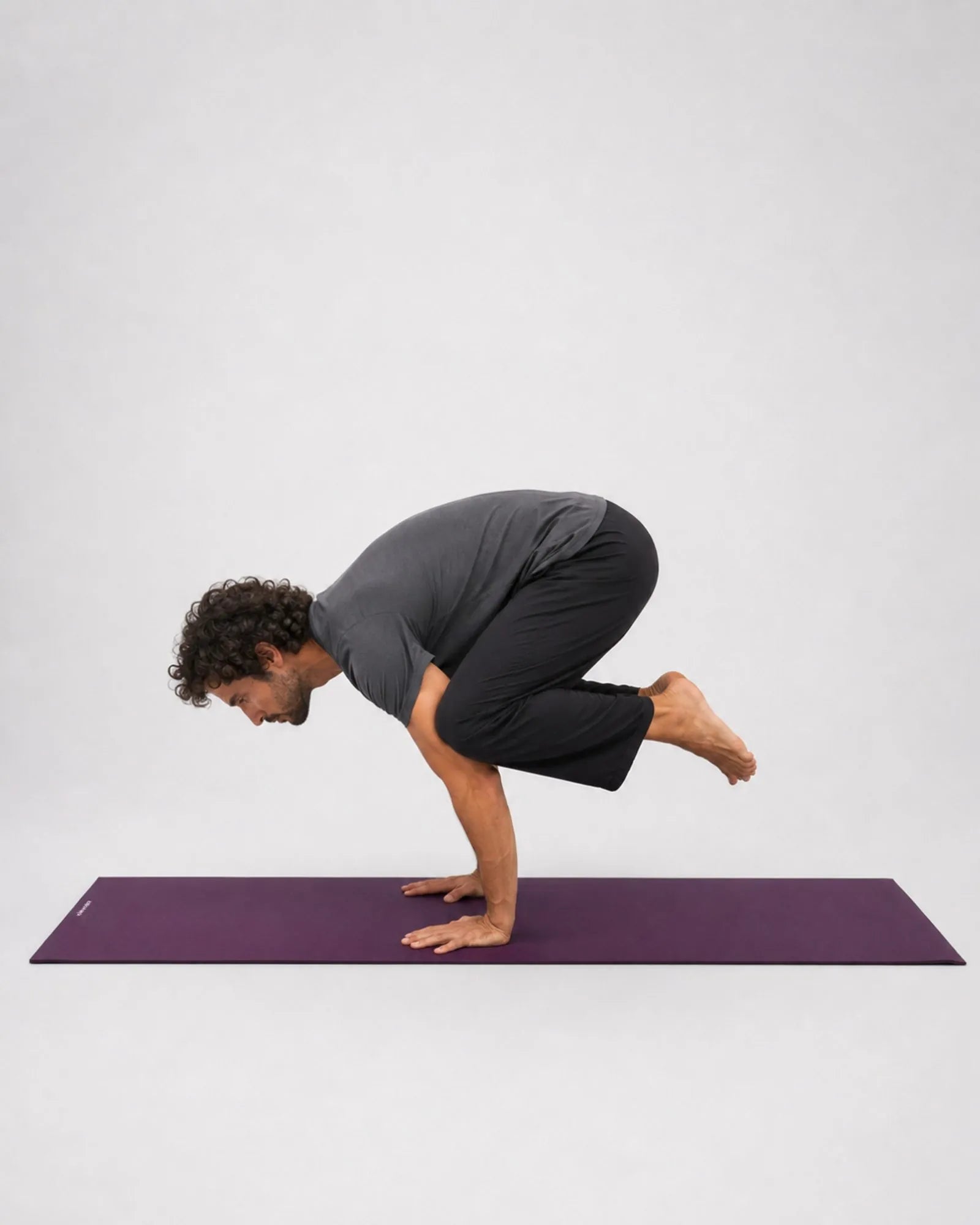
Almost nobody runs the one test that matters before buying a mat: using it in a real practice. Dry, in a shop, with clean hands, almost any surface grips. The problem shows up with movement, friction and sweat. That is where a good non-slip yoga mat makes the difference between slipping and not.
- The grip that matters is the one you get with sweaty hands, not the one from the first five minutes.
- There are three different kinds of grip: dry, wet, and the mat against the floor. Almost no brand says which one it means.
- It comes down to the material, not the texture. Natural rubber grips better than PVC and TPE.
- Density is what keeps the mat still on the floor, and the reason the ones that grip are heavy.
The kinds of grip that matter
There are three, and they are not alike. When a brand promises a non-slip mat, it is worth asking which of the three it means.
- Dry grip is the one from the first five minutes, with clean hands. It is the least realistic: in a real practice there is always movement and sweat.
- Wet grip is the one that decides a yoga class. It is the one that really matters.
- Grip against the floor has nothing to do with the top surface: it is whether the mat stays put on floorboards, tiles or carpet, and whether it creases or lifts off the ground.
With those three names you can work out what a yoga mat is really like. If your hand slides, the problem is the material and the moisture. If the whole mat travels forward in downward dog, the problem is the weight and the base.


On an oléyoga mat, the high-density natural rubber surface is what grips under palms and the soles of your feet. The recycled rubber core is what cushions knees and insteps.
Why sweat changes everything
Grip is not a fixed value. Friction between skin and surface changes with moisture, and therefore with the room, the person and the kind of practice. Sweat creates a thin film between your joints and the mat. That film, sometimes imperceptible, separates the two surfaces and makes everything slippery.


Half an hour of flow and the answer changes: the grip that counts is the one left when your hands are no longer dry.
That is why calling a mat non-slip without saying whether you mean dry or wet means almost nothing. The same product can be excellent at the first and quite poor at the second.
What actually decides grip
Four factors decide whether a yoga mat is genuinely non-slip: material, structure, density and texture.
| Factor | What it changes |
|---|---|
| Material | The dominant variable. Natural rubber beats PVC and TPE by a wide margin, dry and wet |
| Surface structure | A high-density natural rubber surface with a closed-cell micro-granulated finish holds its grip and keeps moisture and bacteria out |
| Density | It is what anchors the mat to the floor, and also what keeps it free of creases as you roll and unroll it |
| Texture | The factor that matters least, though it still counts. A light grain behaves better under friction |
Why oléyoga mats are so non-slip
oléyoga designs its mats around those four factors, to make a mat that is both sustainable and non-slip.
- Material: 100 % natural rubber on both faces. No cork, no polyurethane, no laminated layers on top. It is the material that performs best for grip, and it is sustainable.
- Structure: closed cell. Sweat does not soak into the mat, so the contact area under your hand does not soften halfway through class and the surface does not hold on to odour.
- Density: high-density rubber and 1.8 kg of weight, which keep the mat still when you push in downward dog and in the most demanding poses.
- Texture: a light grain, what we call GoalGrip™. It adds to what the material already does.
Why natural rubber
Natural rubber yoga mats grip better than PVC, TPE, EVA or polyurethane, which are plastic derivatives. And rubber is plant-based: it breaks down over the years and leaves no microplastics behind.
oléyoga commits to a single material, 100 % rubber, because other mats sold as sustainable are in fact laminated blends: cork over a base that is almost never declared, PVC with microalgae, or a layer of polyurethane, however «eco» it is called, over a rubber backing. Those blends are far from sustainable, because they can no longer be separated, and one synthetic layer is enough to stop the whole thing from degrading.
And an uncomfortable truth: no yoga mat is recycled in Europe today, because separating the materials is not viable. So the useful question is not whether it can be recycled, it is how it breaks down. That is where a plant-based material and a laminate with plastic inside, which takes more than two hundred years to disappear, part ways.
Eco Daily · Deep Purple. 100 % natural rubber, 4 mm, reversible. €90
How oléyoga mats are made
Yoga mats are designed in four layers, because grip and cushioning ask for opposite things and one layer cannot deliver both.
For grip, the mats are reversible, with two high-density closed-cell natural rubber surfaces, one on each face, with GoalGrip™ technology, so the mat holds its grip throughout your practice.
For cushioning, an expanded rubber core, AirCore™, which absorbs impact. That core is the reason a 4 mm natural rubber yoga mat weighs 1.8 kg and not the 2.5 kg of a solid one.


The whole production process is designed to be as sustainable as possible: from the material and renewable energy through to kraft paper packaging with no single-use plastic.
And this is what sets them apart from any other natural rubber mat:
- A single material: rubber, with no cork, polyurethane or PVC laminated on top. It is the condition for it ever to be genuinely recyclable, and in the meantime it is what lets it break down instead of fragmenting into microplastics.
- An expanded rubber core: the cushioning of a much thicker mat in only 4 mm, without the weight of a solid one.
- That core is recovered material: up to 85 % recycled rubber, much of it from the offcuts of our own production, so what is left over from making one mat ends up inside the next.
- Both faces are high-density and identical: when one wears out you flip it over and practise on a fresh surface. That is twice the life without buying anything.
- The layers are heat-fused, not glued: there is no adhesive to degrade or come apart over the years. It is the component nobody lists, and the one most often synthetic in a mat sold as natural.
oléyoga mats in five facts
Natural rubber surface
Granulation and GoalGrip™ for high friction from the first use.
Grip that improves with use
It grips well dry. With practice it adapts to your hands and feet.
4 mm, reversible
Cushioning and firmness. Two faces. 185 × 65 cm · 1.8 kg.
Made in Europe
100 % natural rubber, 0 % plastic, OEKO-TEX® certified.
One tree per mat
We plant a tree for every mat sold.
The 4 mm are not an accident. Any thinner and the mat stops cushioning where your knees land. Any thicker and your foot sinks in, and standing poses lose their definition.
In short
Before believing a grip claim, ask which grip it is talking about. Dry, wet and floor grip are three separate questions, sweat changes the answer, and in this category almost nobody measures any of the three. The only verifiable thing is what each mat is made of and how it is built.
What is behind a cheap yoga mat
Grip is not the only reason to look at the material. Every year the yoga industry makes a mountain of plastic that nobody collects afterwards.
PVC needs plasticisers to stay flexible, and those additives are exactly what make it almost impossible to recycle. It does not break down: it fragments over centuries, releasing microplastics along the way. Natural rubber degrades and is the more responsible choice for the environment.

Non-slip eco-friendly yoga mat · 100% natural rubber · 4 mm · Reversible · Eco Daily
100% natural rubber, 4 mm, reversible
- 100% natural rubber, 0% plastic
- 4 mm · 185 × 65 cm · 1.8 kg
- Made in Europe and OEKO-TEX® certified
- Recycled rubber core, no adhesives
- One tree planted for every mat
