
If your hands slide in downward dog once you warm up, the problem is not that your mat lacks grip. It is that it has the wrong kind. Some surfaces improve as moisture arrives and others lose almost everything, and the difference is a property of the material rather than a question of quality or price.
A mat that grips beautifully for the first ten minutes tells you nothing about minute forty.
Why it happens
Friction between skin and a surface is not a fixed number. It changes with how hydrated the skin is, and not in a straight line: a little moisture can raise it, while a continuous film of sweat separates the two surfaces and collapses it. It is well documented in the literature on skin tribology.
That is why the mat that felt perfect in the shop can fail you in a warm room, and why buying a mat described as non-slip without asking dry or wet solves nothing.
Which surfaces actually improve when wet
| Surface | Dry | With sweat |
|---|---|---|
| Cork | Moderate | Improves |
| Open cell rubber or PU | Good | Improves or holds |
| Closed cell rubber | Very good | Drops |
| TPE and PVC | Moderate | Drops sharply |
Cork is the honest answer for heavy sweating. Its surface becomes tackier as moisture arrives, which is the opposite of what most materials do. We compare it properly in natural rubber or cork, including the detail that most cork mats have a rubber base underneath.
The structure matters as much as the material, and it is the thing product pages almost never state: open cell absorbs sweat and closed cell keeps it on the surface.
Try these before you buy anything
- A towel across the top of the mat. The cheapest fix that works, and the one most studios use in hot classes.
- Wipe the mat down properly. A film of old sweat and skin oil on the surface reduces grip on its own, and a new mat carries manufacturing residue.
- Dry your hands on a small towel between sequences. Unglamorous and effective, because you are removing the film rather than fighting it.
- Check your hand position. Spreading the fingers and gripping with the fingertips rather than pressing flat with the heel of the hand changes the load substantially.
If none of those help and your practice is consistently hot and heavy, the mat genuinely is the wrong tool.
How to test a mat before deciding
Do the same pose three times in different conditions, which is more than any product page will tell you:
- Dry, with clean hands. Thirty seconds in downward dog.
- Damp, with lightly wetted palms. Repeat.
- Warm, after a short flow when your hands sweat naturally. Repeat.
The third one is the only one that answers your question, and it is the one nobody does in a shop.
What we would tell you about ours
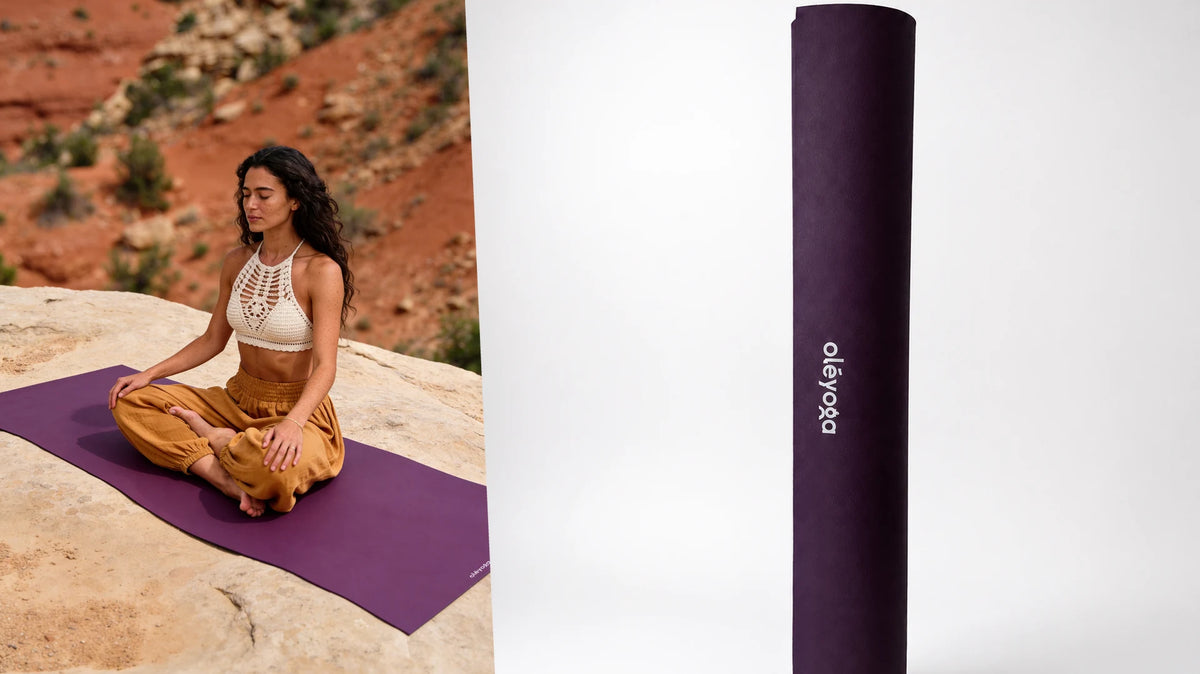
Our mat is 4 mm of natural rubber with a closed cell surface. That is built for dry and moderately damp grip and for staying put on a hard floor. It is very good for a general daily practice.
If you sweat heavily, or you practise hot yoga, it is not the right mat and we would rather say so. What that practice needs is a surface that absorbs instead of keeping the sweat on top, and a towel over the mat is what gets most people through an occasional heated class. The honest version of this article does not end with us.
Common questions
Do grip sprays work?
Briefly. They add tack to the surface and most wash off or build up a residue that reduces grip over time. Check that any spray is safe for your material: alcohol and essential oils damage rubber.
Are grip gloves and socks worth it?
They solve the hand and foot side and do nothing for the mat moving on the floor. Some people find them helpful and others find they change the feel of the practice too much.
Is a thicker mat grippier?
No. Grip comes from the surface and the density, not from thickness. A thicker mat cushions more and can even feel less stable.
Does it get better as the mat ages?
For the first weeks, yes: a new mat improves as the surface wears in. After years it goes the other way, when the surface polishes smooth.
The short version
Sweaty hands are a wet grip problem, not a grip problem. Cork and open cell surfaces improve with moisture, closed cell and plastic ones drop, and a towel solves more than most purchases.
More on what decides grip in our guide to non-slip yoga mats. More about the Eco Daily non-slip natural rubber yoga mat.