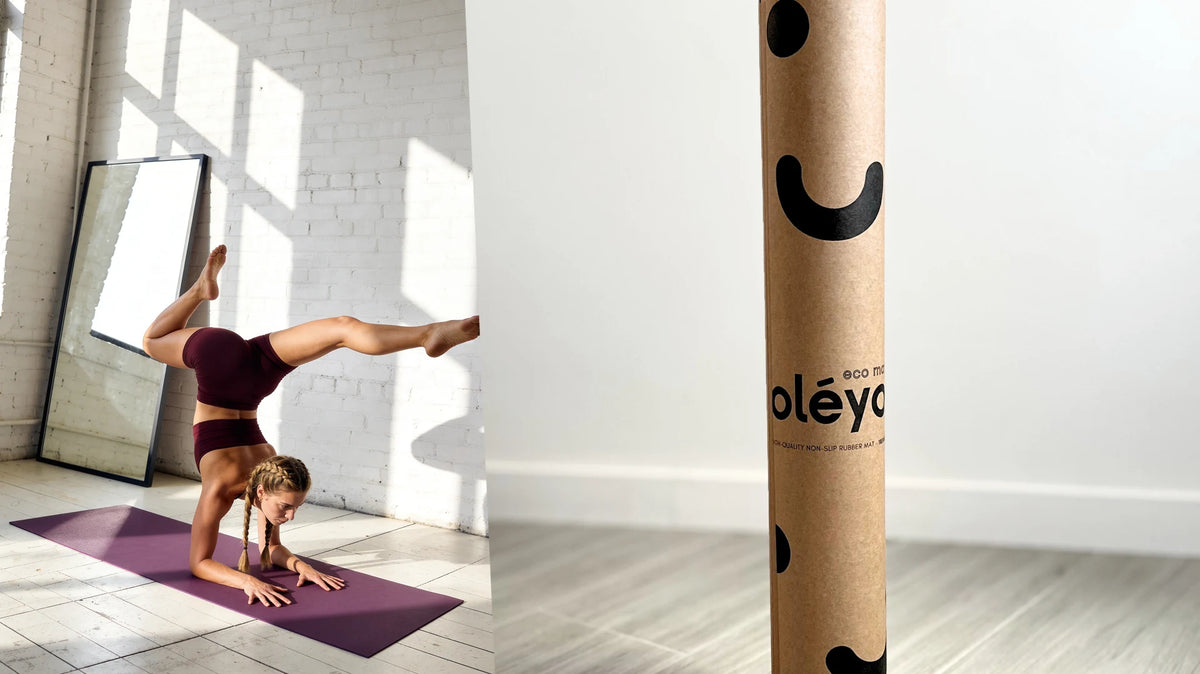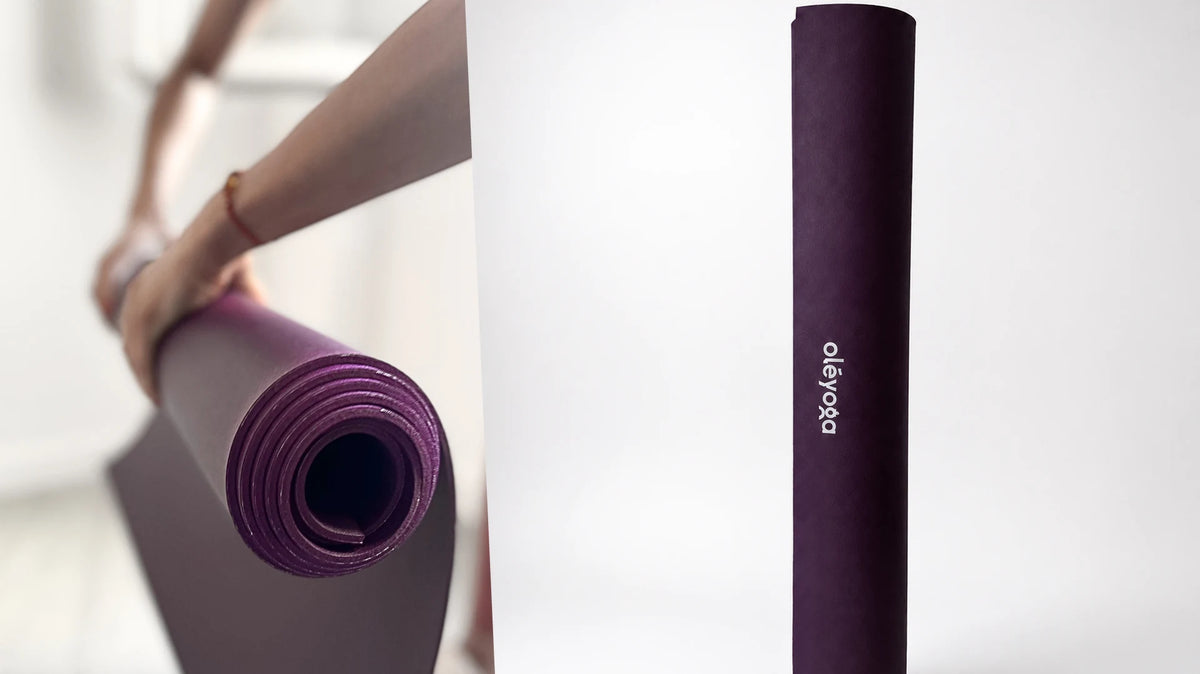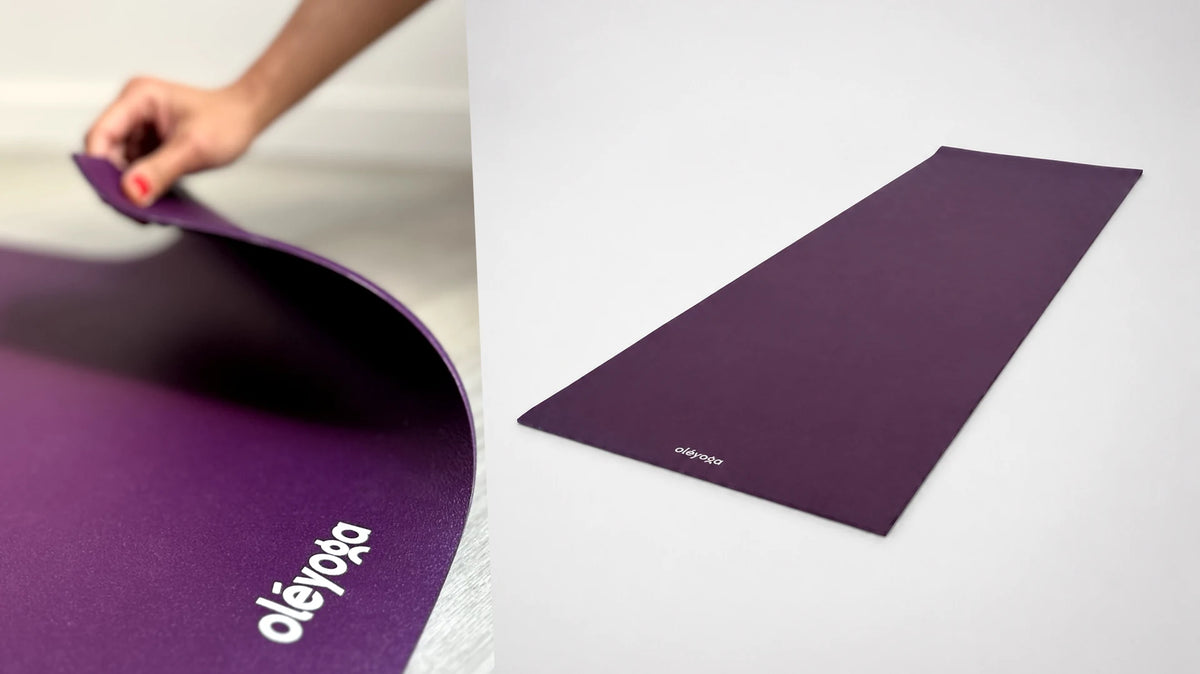

Roll it loosely with the top face out, keep it dry, keep it out of direct sunlight, and do not leave it in the car. Almost every mat that fails early was not worn out by practice. It was stored badly for months, and rubber is the material that punishes that hardest.
You practise on a mat for one hour. It sits somewhere for the other twenty-three, and that is where most of the damage happens.
Rolled or flat?
Rolled, loosely, is right for almost everyone. A tight roll compresses the material along the same lines for months and leaves ridges that take days to relax when you unroll it.
Flat is better if you have the floor space and nothing walks across it. Hanging over a rail is the option people reach for and the one to avoid: rubber creeps under its own weight, and a mat left hanging for weeks develops a stretched section where the rail was.
On which face goes out: roll it with the practice side facing outwards. The surface you stand on then sits on the outside of the curve and is not pressed against itself, which matters on a reversible mat where both faces are textured.
The four things that actually destroy a stored mat
| Condition | What it does | Severity |
|---|---|---|
| Direct sun | UV and ozone degrade rubber. It cracks the surface, and it does not recover | 🔴 |
| The car | Extreme heat in summer, plus sun through the glass. The worst place on this list | 🔴 |
| Stored damp | A permanent sour smell, and mould in the worst case | 🔴 |
| Radiator or heating | Dries out the material and accelerates ageing | 🟠 |
| Weight on top | Marks the surface where it presses | 🟠 |
| Rolled too tight | Ridges that take days to come out | 🟡 |
The sun one deserves repeating because it appears as advice: dry your mat in the sun. Ultraviolet light and atmospheric ozone attack rubber directly, which is well documented in the polymer degradation literature (Polymer Degradation and Stability, 1986), and the cracking it causes is permanent.
Where to keep it
- Indoors, room temperature, away from radiators and out of a sunny window.
- Standing upright in a corner or a cupboard, which is the simplest thing that works.
- Not the boot of the car. Convenient, and the single worst place in this article.
- Not the balcony, not the garage in summer, not a damp basement.
A garden or a terrace looks like it solves the drying problem. It combines sun, damp and temperature swings, which is three of the four failure modes at once.
Carrying it
A strap or a bag protects the edges, which is where mats fray first from being dragged and knocked against door frames.
Two things to watch if it lives in a bag: it has to go in dry, every time, and it should not stay in there for weeks. A rolled damp mat in a closed bag is exactly the recipe for the sour smell in how to clean a natural rubber mat.
Storing it for a long time
If you are pausing practice for months, or the mat is going into storage while you move:
- Clean it and dry it completely first. Anything left on the surface has months to work on the material.
- Roll it loose, or lay it flat with nothing on top.
- Somewhere dark, dry and stable in temperature. Inside a wardrobe beats a garage.
- Not sealed in plastic. Rubber needs to breathe, and a sealed bag traps whatever moisture was left.
- Unroll it for a day before you use it again, and expect a faint rubber smell on the first session.
Common questions
Can I leave it unrolled on the floor all the time?
Yes, and it is the gentlest option, as long as nobody walks on it in shoes and it is not in a patch of sun.
My mat has curled ends. Can I fix it?
Usually. Unroll it the other way for a few hours, or lay it flat with a book at each end overnight. If it has been rolled tight for months, give it a week.
Can I fold it instead of rolling?
Not with rubber. A fold puts a hard crease in a place that flexes every session, and creases become splits.
Does it matter for a PVC mat?
Less. PVC tolerates sun and heat better than rubber does, which is precisely the trade-off in comparing mat materials: the material that decomposes eventually is the material that needs shade.
The short version
Dry, loose roll, indoors, out of the sun, out of the car. That is most of a mat's lifespan decided.
The rest of the routine is in our guide to yoga mat care, and if yours is already past saving, the signs it is finished. Storing and carrying are different problems: the second one is a natural rubber yoga mat for travel.