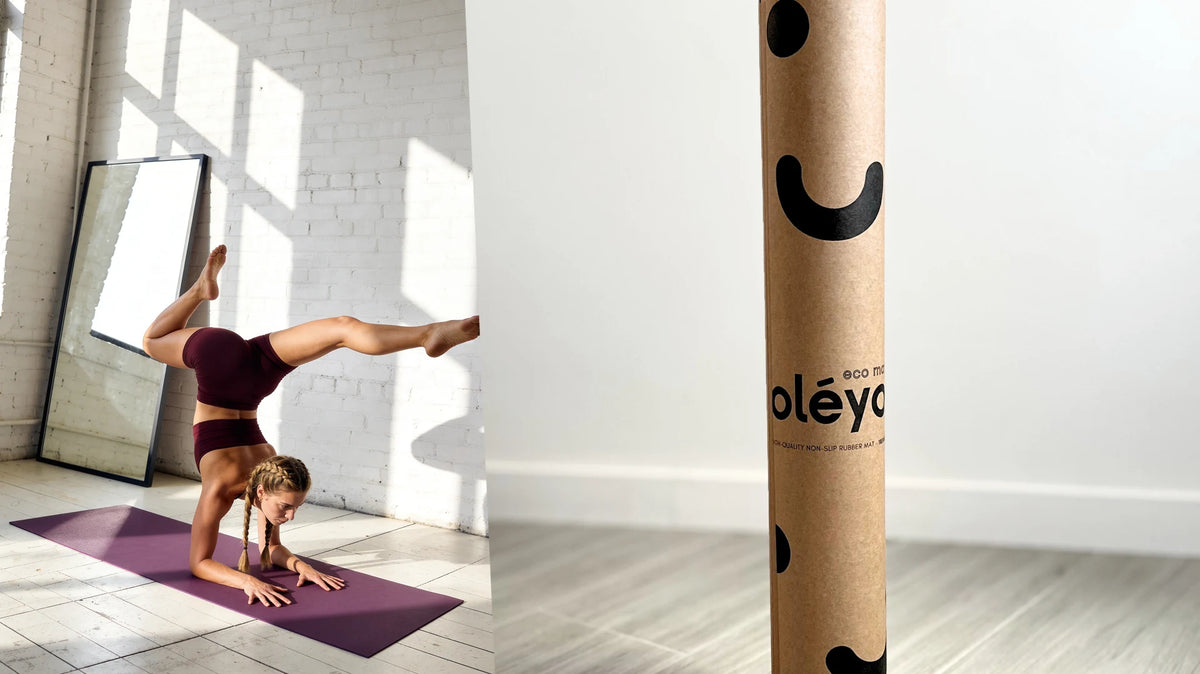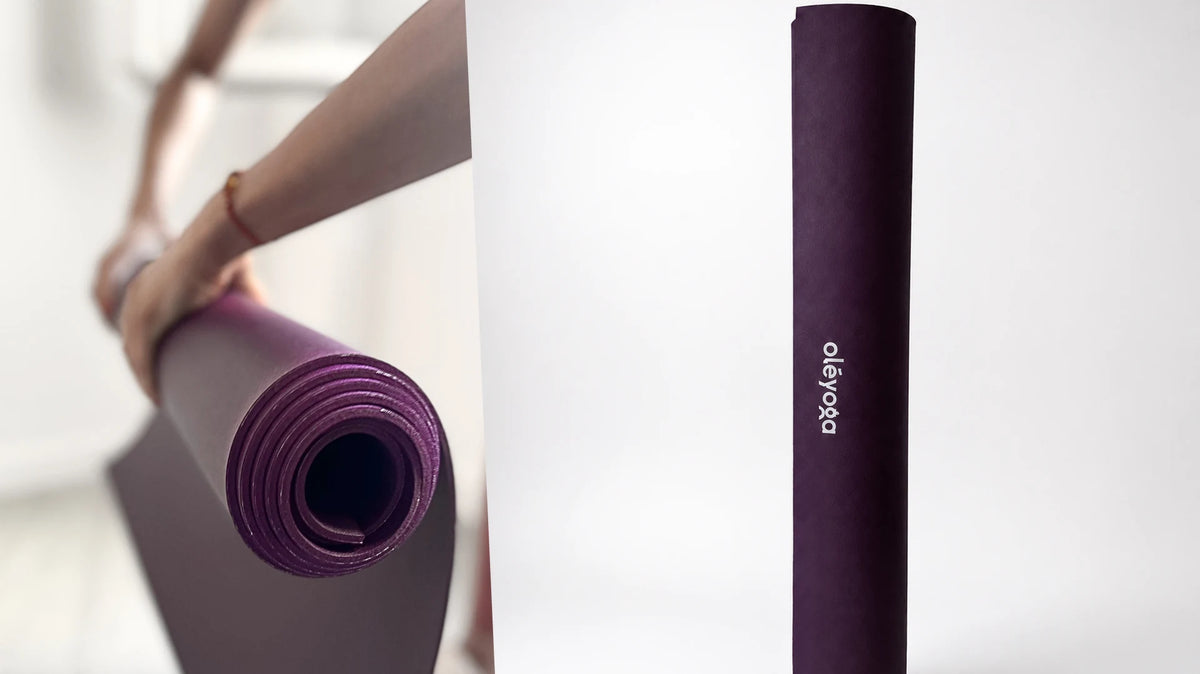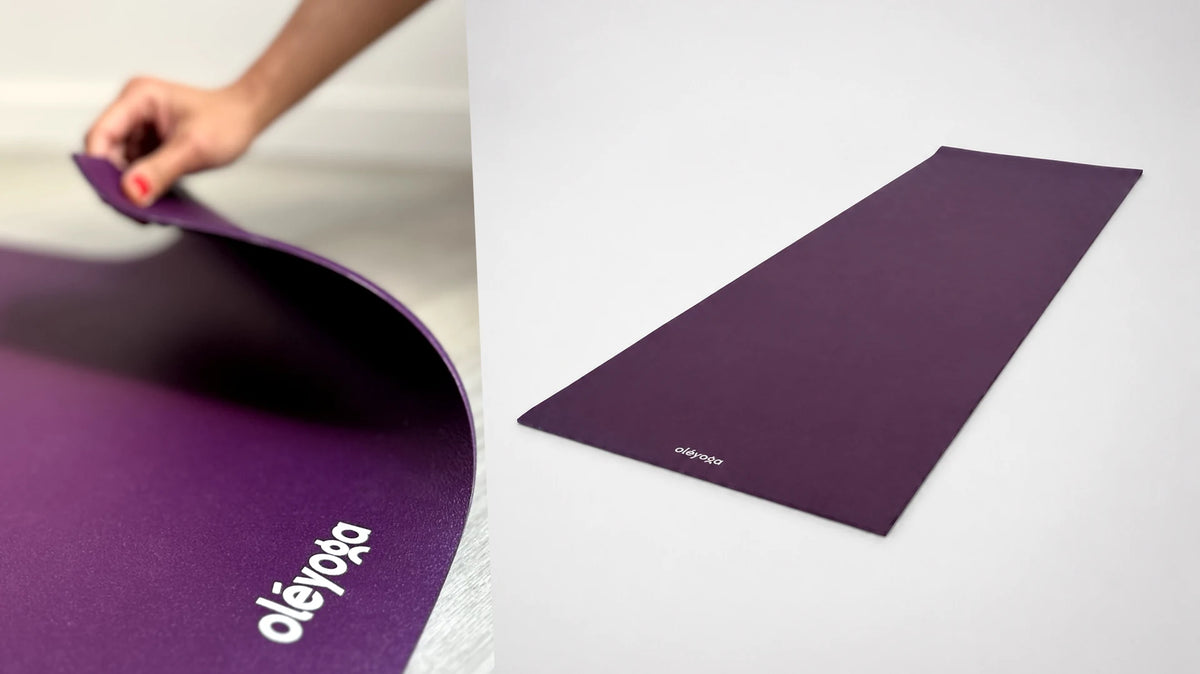

A travel yoga mat is usually 1 to 1.6 mm thick, around a kilo or less, and made to fold into a bag. That is not the same object as a 4 mm daily rubber mat that you take on a trip. Ours is 4 mm and 1.8 kg: light for natural rubber, heavy next to those thin sheets. The useful question is which kind of trip that weight survives, not whether the word travel is on the label.
1.8 kg is light for rubber. It is not light for a rucksack.
What do people mean by a travel yoga mat?
Two products share the search, and the results mix them.
- A dedicated travel mat. Typically 1.3 to 1.6 mm, often foldable, often under a kilo. Built to disappear into luggage. Knees on a hard floor will feel it.
- Your daily mat, taken somewhere. The same 4 mm rubber you practise on at home, rolled into a car, a train, a retreat. Grip and cushioning stay. Packed volume and weight go with you.
The Spanish search esterilla de yoga de viaje is full of the first kind: product pages for 1 mm rubber sheets. We do not make that sheet. We make the second kind, and only for trips where 1.8 kg is still a reasonable carry.
How much should a travel yoga mat weigh?
It depends which job you hired. Weight is not a quality score. It is a trade between packed mass and how the mat behaves on the floor.
| What you are doing | Typical weight | What you get |
|---|---|---|
| Foldable sheet in a backpack | Around 0.7 to 1.3 kg | Packs small. Little cushioning. Fine for a hotel carpet |
| Daily rubber in a car or to a studio | Around 1.8 kg | Same grip and 4 mm as at home. A noticeable carry |
| Solid studio rubber, 6 mm | Often 3 to 4 kg | Stays put. Lives on the floor. Miserable to haul |
If the trip is a weekend by car, 1.8 kg is closer to a laptop than to luggage. If the trip is a week on your back, it is a second pair of shoes you cannot take off. More on why rubber weighs what it weighs in why natural rubber yoga mats are heavy.
Can you take a 4 mm rubber mat on a plane?
Sometimes, and the constraint is shape more than kilos. IATA's passenger baggage rules leave allowances to each airline. As a general reference they cite cabin bags of 56 × 45 × 25 cm, with some weight limits starting at 5 kg.
Our mat is 185 × 65 cm. Rolled along its length, the roll is 65 cm long: that is the width of the mat. 65 cm is longer than the 56 cm IATA cites as a common cabin maximum, so the roll does not fit a typical cabin bag even though 1.8 kg is under 5 kg.
What actually works: a checked bag, a car, or leaving it at the destination. What does not: treating it as an under-seat personal item. Cabin rules still belong to the airline you booked. Check theirs, not this paragraph, the week you fly.
Why is this rubber 1.8 kg instead of 2.5?
Density is what makes rubber grip and stay put. A solid 4 mm natural rubber mat usually lands around 2.5 kg. Ours uses an expanded core (AirCore) so the same thickness weighs 1.8 kg. That is the whole difference between "rubber you can take to a retreat" and "rubber that lives in the studio".
It is still rubber. It is not a 1 mm sheet, and making the core lighter does not turn it into one. Thickness, size and the closed cell surface stay. You keep the practice you already have. You do not get a mat that folds like a newspaper. How to read thickness, density and weight together is in how to choose a yoga mat.
Who should not treat this as a travel mat?
The Eco Daily is 4 mm of 100% natural rubber, 185 × 65 cm, reversible, 1.8 kg, made in Europe. Light for rubber. Heavy next to plastic. Wrong, as a travel tool, if:
- You fly with a mat every month. The roll is 65 cm. Cabin bags are often shorter. Buy a dedicated travel sheet for those weeks and keep this one at home.
- You commute daily on foot or by metro. 1.8 kg, five days a week, is a different problem from a weekend retreat. The honest cost of grip is in the weight article above.
- You need it to vanish into a rucksack. 4 mm of rubber does not fold small. A 1.3 mm sheet does. That sheet is a different product, with different knees on a hard floor.
We would rather you took the right object than be disappointed by ours in an airport queue.
Common questions
Is 1.8 kg a travel yoga mat?
It is a portable daily mat. Call it a travel mat only if the trip is a car, a train, or a bag large enough for a 65 cm roll. It is not a backpack mat.
Should I buy a 1 mm mat for holidays and keep this for home?
If you fly often, two mats is the honest setup: a thin one that packs, and a 4 mm one that practises. If you travel a few times a year by car, one 1.8 kg mat is simpler.
Will folding 4 mm rubber ruin it?
Do not fold it. Roll it. A tight roll along the length, 65 cm long, is how this mat is meant to travel. Creases in dense rubber take time to forget.
Does it grip on a hotel floor?
Closed cell natural rubber holds on smooth hard floors. That is the point of taking it. A 1 mm sheet on the same tiles is a different conversation about cushioning, not about grip.
The short version
A travel yoga mat, in the shops, is a thin foldable sheet. A travel yoga mat, if you still want 4 mm of rubber, is 1.8 kg in a car or a large bag, and not in a rucksack. Ours is the second. It is the wrong buy for the first.
More on the material in our guide to natural rubber yoga mats. The mat itself is the Eco Daily non-slip natural rubber yoga mat.
______________________
oléyoga makes yoga mats from natural rubber, without plastics, in Europe. One mat, made to be kept.