
Yes, and it is the most common surprise people have when they unroll one. The smell comes from vulcanising, the process that turns tree sap into a mat, and it fades over the first days of use. It is also, counterintuitively, a sign of what you bought rather than a sign that something is wrong.
The mats that smell least are often the ones with the least rubber in them.
Where the smell comes from
Natural rubber starts as latex tapped from the Hevea brasiliensis tree. On its own that sap is sticky and useless as a mat, so it is vulcanised: heated with sulphur until the polymer chains cross-link and the material becomes elastic and durable.
That process leaves behind volatile compounds, and sulphur is one of them. What you are smelling when you open the packaging is those compounds evaporating. It is strongest in the first hours because the mat has been rolled and wrapped, concentrating everything it was releasing in transit.
How long does it last?
It is a mild, earthy smell rather than a strong one, and it goes over the first days of regular use. How fast depends on three things you can actually control: airflow, temperature and whether the mat spends its life rolled up.
Rolling it up traps the compounds against themselves and slows everything down. A mat left unrolled in a ventilated room loses it much faster than one stored rolled in a cupboard between sessions. If the smell is bothering you, the single most effective thing is to stop rolling it for a few days.
What actually speeds it up
- Unroll it and leave it out. Flat, in a room with air moving through. This does most of the work.
- Wipe it down. Water with a little mild soap on a cloth, then let it dry flat. Repeat after a few sessions in the first days.
- Practise on it. Use accelerates it. The surface warms, the compounds leave faster, and it is more pleasant than waiting.
What does not help: baking soda buried in the roll, vinegar, essential oils. The first does very little, and the last two attack the surface. Essential oils in particular break down rubber over time, which is why they turn up on every list of things not to clean a mat with.
The advice that will ruin your mat
Search this question in English and you will be told to leave the mat in the sun. It is the most repeated tip online and it is the one thing you should not do.
Ultraviolet light and atmospheric ozone degrade natural rubber. Ozone attacks the carbon-to-carbon double bonds in the polymer, producing the surface cracking that rubber chemists have studied and formulated against for decades: it is a well documented enough failure mode to have its own countermeasures literature, such as this review of ozone attack on rubbers. Sunlight will fade the colour, dry the surface and eventually crack it, and once the top layer cracks the grip goes with it.
You would be trading a smell that was going to disappear anyway for permanent damage. Shade and moving air do the same job without the cost: a balcony out of direct sun, an open window, a room with a fan.
Is the smell harmful?
It is not pleasant, and for most people it is not a health concern either. The compounds released are the same family you would meet from any new rubber product, and they dissipate.
The exception worth naming is latex. The smell itself is not the allergen, but a natural rubber mat does contain latex proteins, and if you have a diagnosed latex allergy that is a separate and more serious question. We go through it properly in what a latex allergy means for a rubber mat.
If you get headaches or irritation from the smell rather than mild dislike, ventilate the room harder and give it more time before deciding whether the mat works for you.
Does a strong smell mean poor quality?
Usually the opposite, and this is the part that surprises people.
The smell comes from the natural rubber content, so the mats that smell least are often the ones with the least of it. A PVC or TPE mat has little or no rubber smell because there is little or no rubber in it. A mat that is heavily blended with synthetic rubber smells less than one that is not.
That does not mean stronger is always better. It means the absence of smell is not the quality signal people assume it is, and if a mat is sold as natural rubber and arrives with no smell at all, the composition is worth a second look.
When a smell is a problem
Three situations are different from the ordinary vulcanising smell and worth acting on:
- A chemical or solvent smell rather than an earthy rubber one. That points to adhesives or coatings rather than the rubber itself.
- A smell that has not faded at all after a couple of months of unrolled, ventilated use.
- A sour or musty smell that appears later. That is not vulcanising, it is moisture. The mat is being rolled or stored damp after sweaty sessions, and it needs cleaning and drying flat rather than airing.
What we do about it
Our mats are 100% natural rubber with no PVC and no synthetic blend, which is precisely why they arrive with a smell. We would rather explain it than reformulate the material to avoid an awkward first impression.
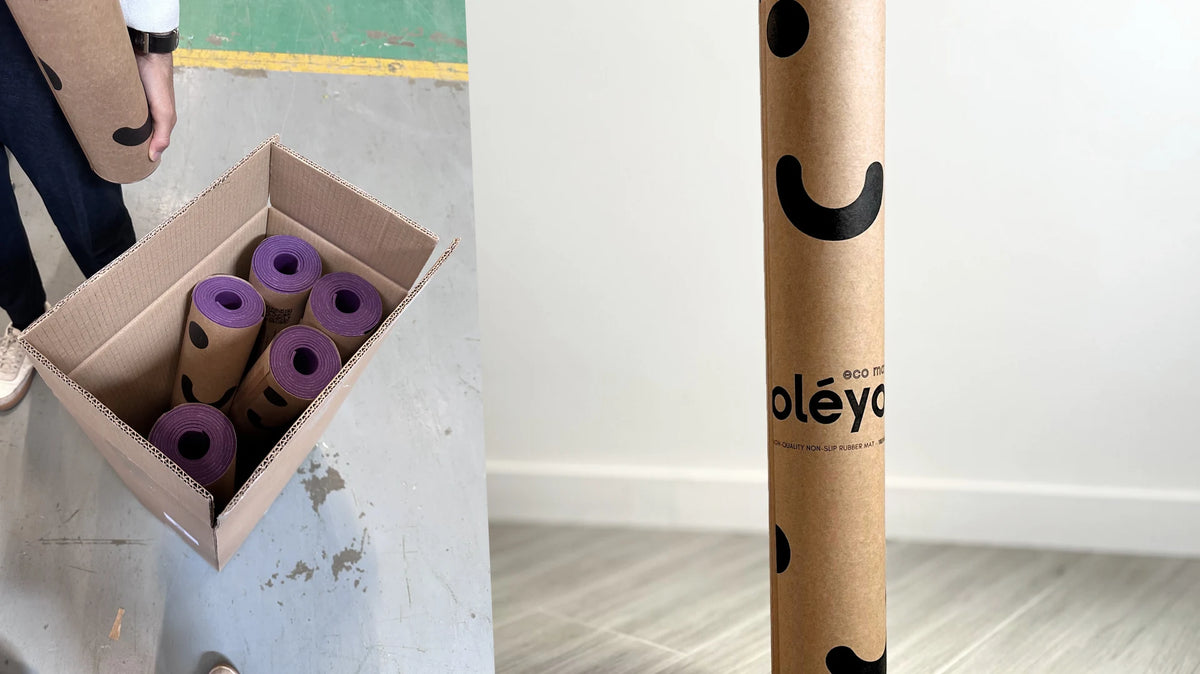
They ship rolled, because that is the only sensible way to ship a mat. So the honest instruction is the one at the top: unroll it when it arrives, leave it out, and give it a few days of use before judging it.
Common questions
Can I wash it to remove the smell faster?
You can wipe it with water and mild soap, and it helps. Do not soak it, do not put it in a washing machine, and dry it flat in the shade.
Will freezing it work?
No. It is sometimes suggested and there is no mechanism behind it. Cold slows evaporation, which is the opposite of what you want.
Does the smell come back?
The vulcanising smell does not. A musty smell can appear later if the mat is stored damp, and that is a cleaning problem rather than a material one.
Do cork or TPE mats smell?
Cork has a mild smell of its own that most people like, though many cork mats have a rubber backing that smells like rubber. TPE has a faint plastic smell that fades quickly.
The short version
The smell is real, it is temporary, and it is a consequence of the material rather than a defect in it. Unroll the mat, keep it out of the sun, use it, and it goes.
There is more on what the material is and how it compares in our guide to natural rubber yoga mats, and if you want to see how it holds up over the years, we looked at how long a natural rubber mat lasts. More about the Eco Daily non-slip natural rubber yoga mat.