
TPE is not biodegradable. It is a thermoplastic elastomer made from petroleum, and you will find it described as biodegradable on some of the highest ranking pages in Spanish and English. It is recyclable in theory, which is a real improvement on PVC, but recyclable and biodegradable are different claims and only one of them is true here.
TPE is a decent material with a dishonest label.
What is TPE, actually?
TPE stands for thermoplastic elastomer. It is a family of materials that behave like rubber but melt and reset like plastic, which is exactly why manufacturers like it: a TPE mat can be extruded fast, cheaply, in any colour, with no vulcanising step.
The base polymers are petroleum derived. Most yoga mats sold as TPE use SEBS or a similar styrenic block copolymer, sometimes blended with EVA. The materials science literature on thermoplastic elastomers describes the family in detail, and what it does not describe is any biological breakdown pathway. Nothing in that chain starts with a plant. It is a better plastic than PVC, and it is still a plastic.
Is TPE biodegradable?
No. There is no mechanism by which a petroleum based block copolymer breaks down biologically in soil or landfill, and no manufacturer publishes a standard test showing that it does. If a mat were genuinely biodegradable you would expect a certification against a recognised standard, and you will not find one on a TPE mat.
This matters because the claim is everywhere. Search the question in any language and you will find TPE mats sold as biodegradable on product pages and in buying guides, with no test and no standard behind the word. If that is the first thing you read while comparing materials, you are comparing on a fact that is not one.
The honest version of the sustainability argument for TPE is recyclability, not biodegradability. Which brings us to the next question.
Is TPE recyclable in practice?
In theory yes, and that is genuinely one of its advantages: TPE can be melted and reprocessed, which PVC effectively cannot.
In practice, a used yoga mat is a hard object to recycle anywhere:
- It is large and dirty. Kerbside collection is not set up for a sweaty two metre sheet of elastomer.
- It is often multi layer. A surface bonded to a base cannot go into a single material stream.
- There is no take back scheme. Almost no brand in Europe runs one.
A material that is recyclable in a factory is not the same as a mat that gets recycled. If you buy TPE for this reason, check whether the brand actually operates a return programme, because most do not.
Is TPE better than PVC?
Yes, and it is worth saying clearly because the comparison is often skipped.
PVC needs plasticisers to stay flexible, historically phthalates, and it does not decompose so much as fragment into microplastics over a very long time. TPE needs no plasticisers, contains no chlorine, and can be reprocessed. Between the two plastics TPE is the less damaging one on every environmental axis and most health ones, which is a comparison between two petroleum products rather than a recommendation of either.
TPE is not the worst plastic on the market. It is still a plastic, and the word that gets attached to it is the problem.
TPE or natural rubber?
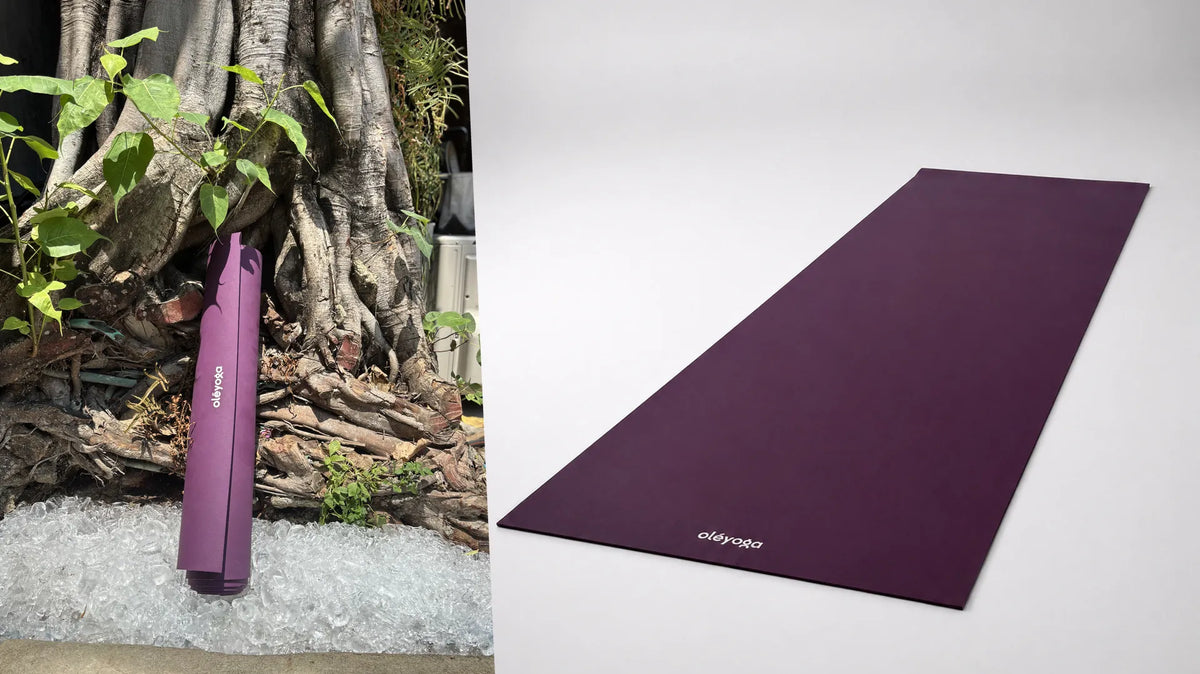
We make one mat and it is natural rubber, so we have a position and here it is, stated rather than buried under a table: TPE is a plastic made from petroleum, and a plastic is not what a yoga mat should be made of. The comparison below is with that on the record.
| TPE | Natural rubber | |
|---|---|---|
| Origin | Petroleum | Tapped from a living tree |
| End of life | Recyclable, not biodegradable | Breaks down over years |
| Grip when damp | Moderate, tends to get slick | Holds |
| Weight (4 mm) | Around 1 kg | 1.8 kg on ours |
| Latex | None | Contains latex |
| Price | Lower | Higher |
TPE is lighter, cheaper and free of latex, and those differences are real. None of them touches the first row. It starts as petroleum and it stays petroleum, and a mat that outlives several of its owners in a landfill is not a sustainable purchase whatever the label says.
If natural rubber is ruled out for you
There is one reason to look past natural rubber, and it is medical rather than a matter of taste. A diagnosed latex allergy. Natural rubber contains latex proteins, so it is not a choice to take lightly, and what a latex allergy actually means for a yoga mat is worth reading first.
If rubber is ruled out, the materials worth looking at come in an order, and it is not the order a search result will give you:
- Cork with a polyurethane base. Bark harvested without felling the tree, and the only latex-free option whose surface is a plant.
- Jute or organic cotton. Plant fibres, less cushioning, and a real answer for a light practice.
- TPE, last. It is petroleum and it does not break down. If nothing above works for you it is what remains, and it is worth knowing that is what you are buying.
What is not a reason to choose it is the environment. If you are buying TPE because a product page told you it was biodegradable, that is the one argument that does not hold.
Why we can say this
We sell one mat in one material, which means we have nothing to lose by describing TPE accurately and nothing to gain by exaggerating. A retailer that stocks TPE, PVC, cork and rubber has to write something positive about all four.
Our own mat is 4 mm of natural rubber, made in Europe, and it is heavier and more expensive than a TPE mat. We think the grip and the end of life are worth it. That is an argument, not a fact, and you should be able to tell the difference on any page that is trying to sell you something.
Common questions
Is TPE toxic?
The TPE used in mats is generally considered low risk and contains no phthalates or chlorine, which is the main health argument against PVC. Look for an OEKO-TEX or equivalent certificate rather than the word "non toxic" on its own.
Is TPE vegan?
Yes. It is synthetic and involves no animal product. Natural rubber is also vegan, since tapping does not harm the tree.
Does a TPE mat smell?
Usually less than natural rubber, and the smell fades faster. That is another honest point in its favour, and we explain why rubber smells at all separately.
How long does a TPE mat last?
Generally less than a rubber mat under the same use. TPE compresses and the surface texture wears down, which is the point at which grip goes.
The short version
TPE is a petroleum plastic, less damaging than PVC, lighter and cheaper than natural rubber, and not biodegradable however often a label says it is. The only reason to choose it over rubber is a latex allergy, and even then there are plant materials to look at first.
If you want the full picture across every material, we compare them side by side in our guide to yoga mat materials, and go deeper on ours in what natural rubber actually is. More about the Eco Daily non-slip natural rubber yoga mat.