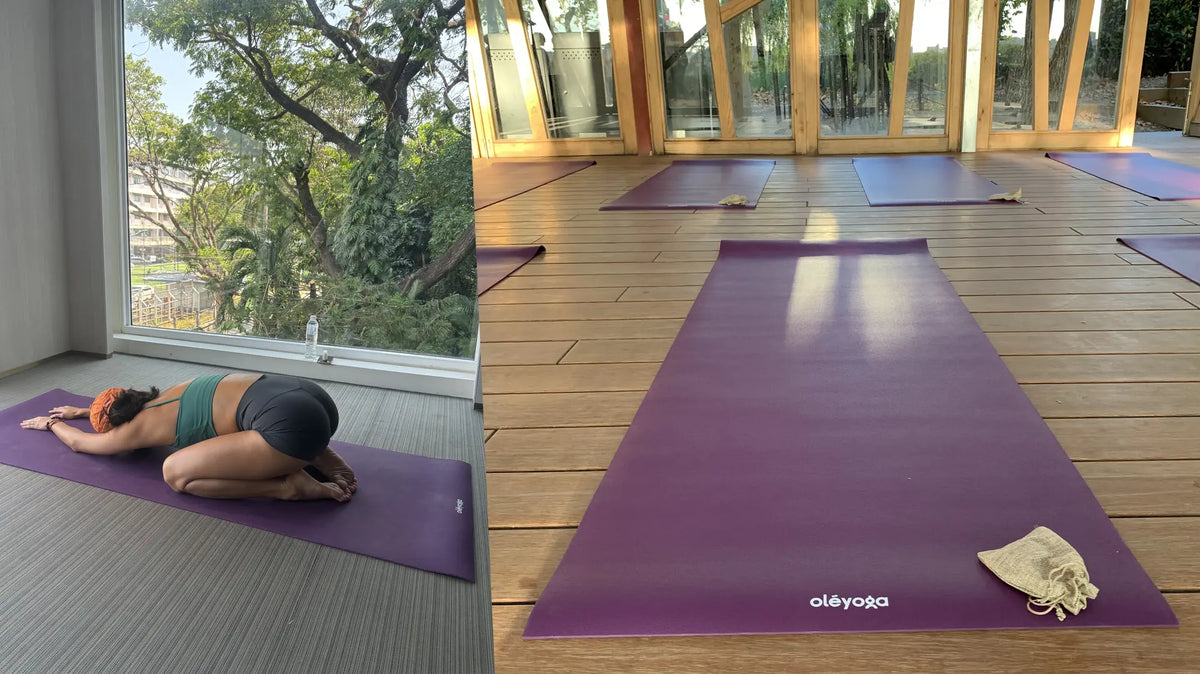

Yin holds floor postures for three to five minutes, with very little sweat and a lot of bone in contact with the ground. The obvious conclusion is a thicker mat. What matters is whether the surface stops compressing, and whether you put a blanket under the knee, hip or sacrum. A dense 4 mm holds its support through a five-minute hold. The extra millimetres are a comfort story that does not survive the pose.
Thickness is how far the mat can give. In a long hold, the only question is whether it stops.
Is a thicker mat better for yin?
It is the advice shops repeat, and it confuses softness with support. Soft foam gives more in the first thirty seconds and then keeps giving until you are effectively on the floor. That slow bottoming-out is compressive creep, a known behaviour of polymeric foams under sustained load (the foam literature measures it; the paper itself sits behind a publisher wall).
A dense 4 mm reaches a depth and stays there. A soft 6 mm feels kinder at first and harder by minute four. That is why people describe a thick mat as getting firmer during the hold. It did not get firmer. It ran out.
What a yin class actually asks of a mat
Almost no grip, almost no sweat, and a lot of time on the floor. That is a different assignment from vinyasa. Buying a yin mat usually means buying something that makes the rest of the week worse.
| What the class does | What the mat has to do |
|---|---|
| Three to five minutes on a knee or hip | Stop compressing. Softness that keeps going is the floor arriving slowly |
| Almost no jumping, almost no sweat | Grip is the wrong reason to buy it |
| A standing class later the same day | Stay dense enough that a warrior does not wobble |
| A bone on the ground | A folded blanket, not four extra millimetres everywhere |
Our Eco Daily is 4 mm and 1.8 kg. It is not the softest thing you can lie on. It is dense enough that a long hold does not disappear underneath you. How to read that number when you are still in the shop is in how to choose a yoga mat.
When does a blanket beat any millimetre?
Sustained pressure on a knee, an ankle bone or the sacrum is uncomfortable past a point on any surface. Four extra millimetres spread that pressure a little and apply it everywhere, including where you did not want softness. A folded blanket sits only where the bone is.
For the poses that press a joint into the ground, the honest answer is not a mat at all. In restorative work, where everything is already supported on bolsters, the mat matters least of the three. Yin still uses the mat as the floor. Restorative barely uses it. Do not buy a second mat for the class you take once a week.
What if yin is in the morning and standing work comes later?
Most people who practise yin also practise something that stands up. A mat bought only for the floor sequence makes the warrior in the evening worse, because you have added exactly the instability a flowing class cannot use.
One dense 4 mm mat plus a blanket is the combination that serves both. Doubling two mats for a specific pose and folding the spare away is fine. Living on a 6 mm foam because Tuesday is yin is how the rest of the week loses its base. Matching the mat to the practice you actually do, not the one on the timetable, is the point of choosing a yoga mat for your style of practice.
Who is this mat not for?
The Eco Daily is 4 mm of 100 % natural rubber, 185 × 65 cm, reversible, 1.8 kg, made in Europe, closed cell, certified OEKO-TEX®.
It is the wrong mat if:
- You want a mattress. 4 mm dense rubber will feel firm on the hip. That is the point, and a blanket is the local fix.
- You have a diagnosed latex allergy. Natural rubber contains latex. Take that to your allergist; the detail is in yoga mats and latex allergy.
- Yin is your only practice and you already own bolsters, blankets and a carpeted room. The mat is doing almost none of the work. Keep what you have.
Common questions
Is 4 mm enough for yin?
For most people and most poses, with a blanket for the ones that press on a bone. Soft 6 mm is not “more enough”. It is a different, less stable material that happens to be taller.
Should I double the mat for yin and fold it for vinyasa?
Doubling for a floor sequence and putting the second mat away is reasonable. Leaving both down for standing work is how the ankle starts to roll.
Does yin need grip?
Almost none. You are not jumping and you are barely sweating. Grip is the wrong reason to buy a yin mat, which is why a surface built for daily vinyasa still works on the floor.
The short version
Yin wants density that stops compressing, and a blanket where a bone meets the floor. It does not want a thicker mat. Four millimetres of natural rubber plus a folded blanket is the honest setup. Six millimetres of soft foam is the comfortable first minute.
Style by style in the best yoga mat for every practice. The mat itself is the Eco Daily non-slip natural rubber yoga mat.
______________________
oléyoga makes yoga mats from natural rubber, without plastics, in Europe. One mat, made to be kept. Even in stillness the hands and feet still have to hold, which is the subject of non-slip yoga mats.