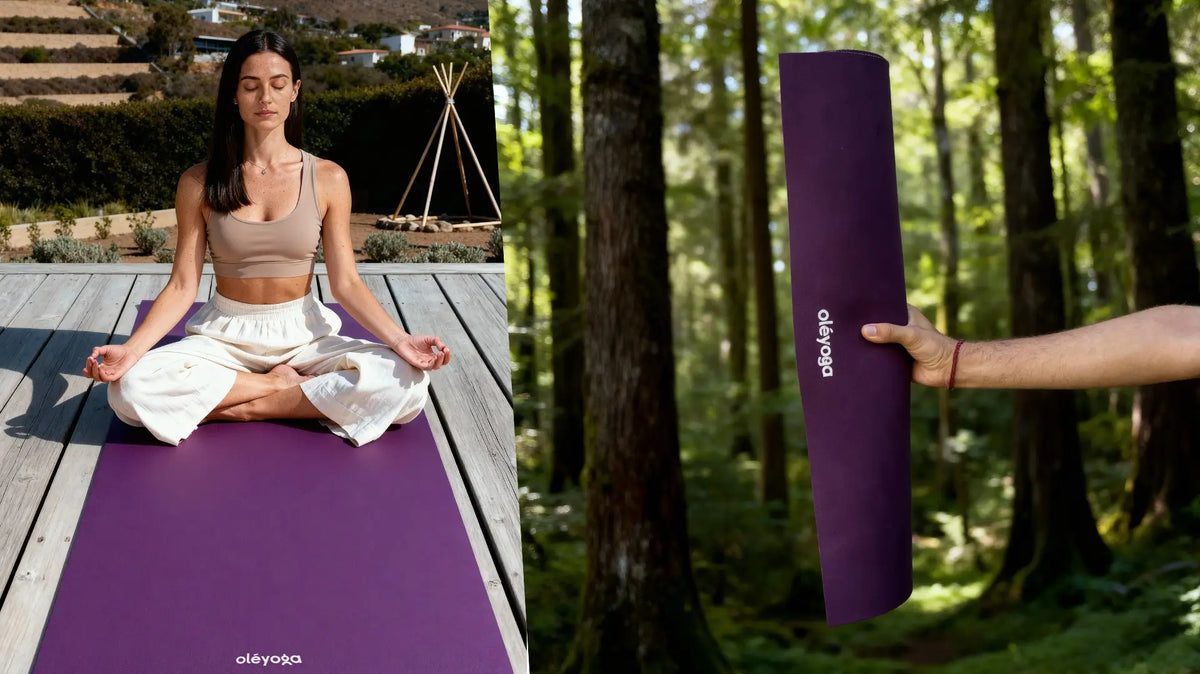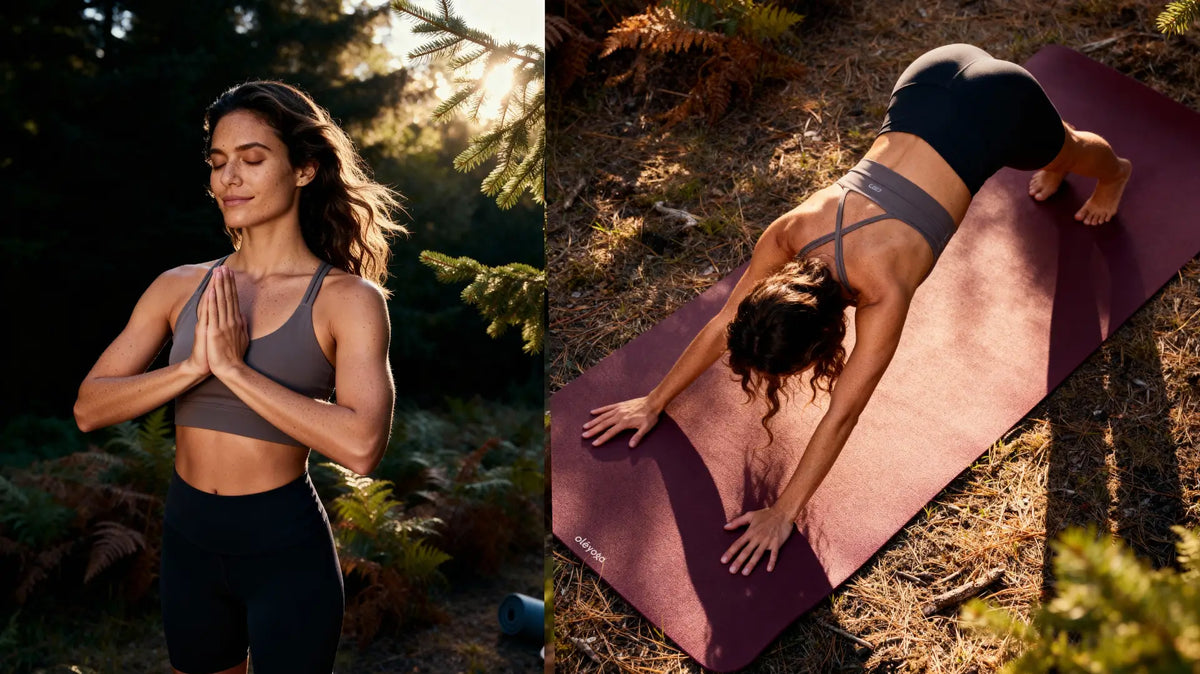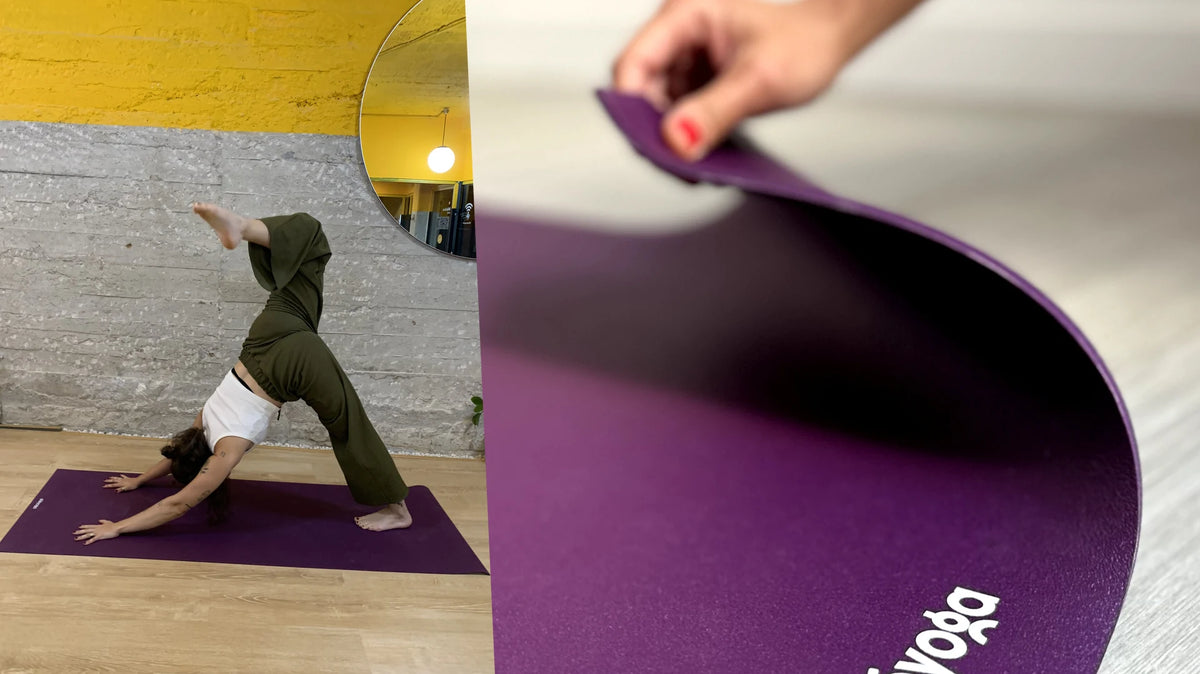

Vinyasa links posture to posture with the breath. Sweat builds through the hour, the hands land before they have settled, and every extra millimetre of softness costs you the standing work. You need a surface that still grips when it is damp, a mat that does not travel on a hard floor, and density that keeps a warrior from turning into a wobble. Four millimetres of dense natural rubber is built for that class.
The shop demo is dry. The class is not. Buy for minute forty, not for minute one.
What does a vinyasa class ask of a mat?
Three things at once, and they pull in different directions:
- Grip that degrades slowly. Friction between skin and a surface changes with moisture, and not in a straight line: a little damp can raise it, a continuous film of sweat separates the two surfaces and collapses it (a review of skin tribology).
- Stability under the foot. Fast sequences are full of standing poses and balances. A surface that sinks takes the ankle with it.
- A base that stays put. Hands sliding on the mat and the mat sliding on the floor are different problems. The second one is why you slip on a yoga mat, and weight plus the underside decide it.
If the class links breath to movement, the load on the mat is a vinyasa load. Power yoga, sculpt and flow ask for the same three.
Why is 4 mm more stable than 6 mm in a flowing class?
Thicker is sold as more supportive. In a vinyasa it is usually less stable. The foot and the hand sink, the joint chases them, and the sequence that was supposed to feel light starts to feel effortful in the wrong places.
| Dense 4 mm | Soft 6 mm | |
|---|---|---|
| Standing balances | The foot meets a floor that stops | The foot rolls as the foam gives |
| Plank and chaturanga | The wrist stays stacked | The palm sinks; the wrist extends further |
| Knees in a lunge | Firm. A blanket still wins for bony contact | Softer at first, then you are on the floor anyway |
Thickness is how far the mat can compress. Density is whether it stops. Ours is 4 mm and 1.8 kg, which is dense for that thickness.
Why does the grip have to last an hour, not a shop demo?
Every mat grips when it is dry. The comparison that means anything is where each one stops as the hands warm up. Natural rubber holds further into the damp range than PVC or TPE because the surface can still deform into the skin after a film has started to form. Closed cell rubber does not soak that film in. That is why it wipes clean, and why a genuinely soaked class is a different assignment.
If your vinyasa is a heated room with continuous sweat, this is not the mat, and we would rather say so than have you find out in week three. For a normal studio class that warms as you work, closed cell rubber from day one is the job. The mechanics of wet palms are in the yoga mat for sweaty hands.
Will you actually take it to the studio?
A solid natural rubber mat at 4 mm often weighs around 2.5 kg. An expanded core is what keeps ours at 1.8 kg. That is still not a travel mat, and we do not sell it as one. It is the difference between taking rubber to class and leaving it at home.
If you commute on foot every day, 1.8 kg is a real cost, and it is also most of why the mat does not skate on a polished studio floor. That is the trade. A 1 mm fold-up fits a cabin bag and will not be this surface.
Who is this mat not for?
The Eco Daily is 4 mm of 100 % natural rubber, 185 × 65 cm, reversible, 1.8 kg, made in Europe, closed cell, certified OEKO-TEX®. Built for a general daily vinyasa on a hard floor.
It is the wrong mat if:
- The class is hot yoga. Closed cell keeps sweat on top. A towel over whatever you already own is the honest answer in that room.
- You have a diagnosed latex allergy. Natural rubber contains latex. Take that to your allergist; the detail is in yoga mats and latex allergy.
- The mat has to fit in a cabin bag every week. At 1.8 kg it will not, and a fold-up is a different product.
Common questions
Is 185 × 65 cm long enough for a step back?
For most people, yes. The tell is whether you glance at the back edge every time you step to a lunge. Extra length helps if you are tall. Extra width helps if the hands wander in downward dog.
Do I need a towel in a normal vinyasa?
Not if the room is unheated and your hands only dampen. If they are wet for most of the hour, a small towel at the top of the mat beats any surface claim. It also beats buying a second mat.
Will a sticky polyurethane top feel more secure?
It will feel more dramatic, especially dry. It can also fight the transitions, and it is a plastic layer on whatever sits underneath. Rubber without that layer is the material we make.
The short version
Vinyasa wants grip that lasts the hour, density that does not sink, and a mat you will carry. Four millimetres of closed cell natural rubber is built for that class. A heated room is not that class.
More on matching a surface to how you practise in choosing a yoga mat for your style of practice, and style by style in the best yoga mat for every practice. The mat itself is the Eco Daily non-slip natural rubber yoga mat.
______________________
oléyoga makes yoga mats from natural rubber, without plastics, in Europe. One mat, made to be kept. The surface side of that speed is covered in our guide to non-slip yoga mats.