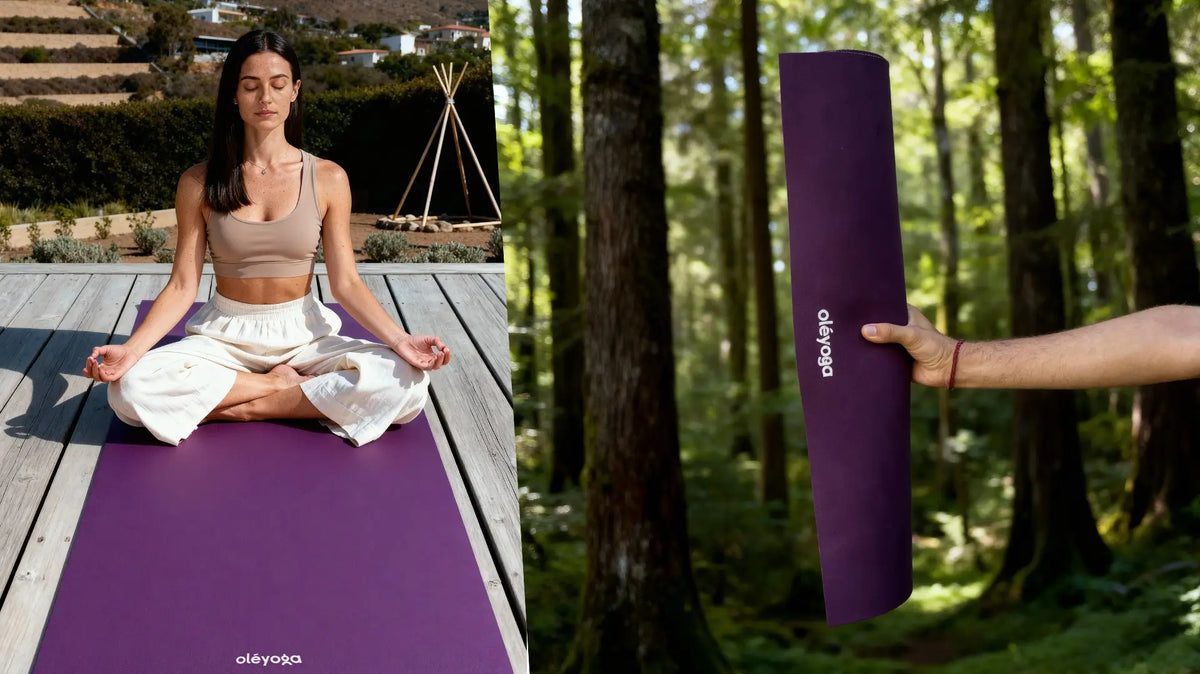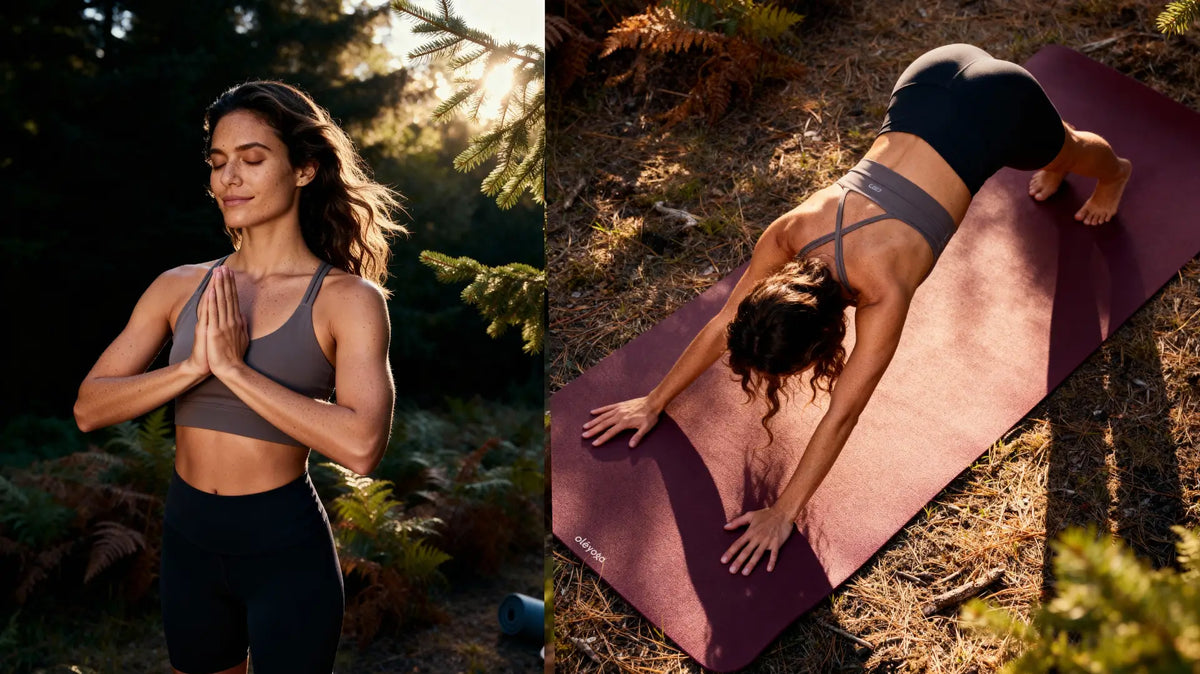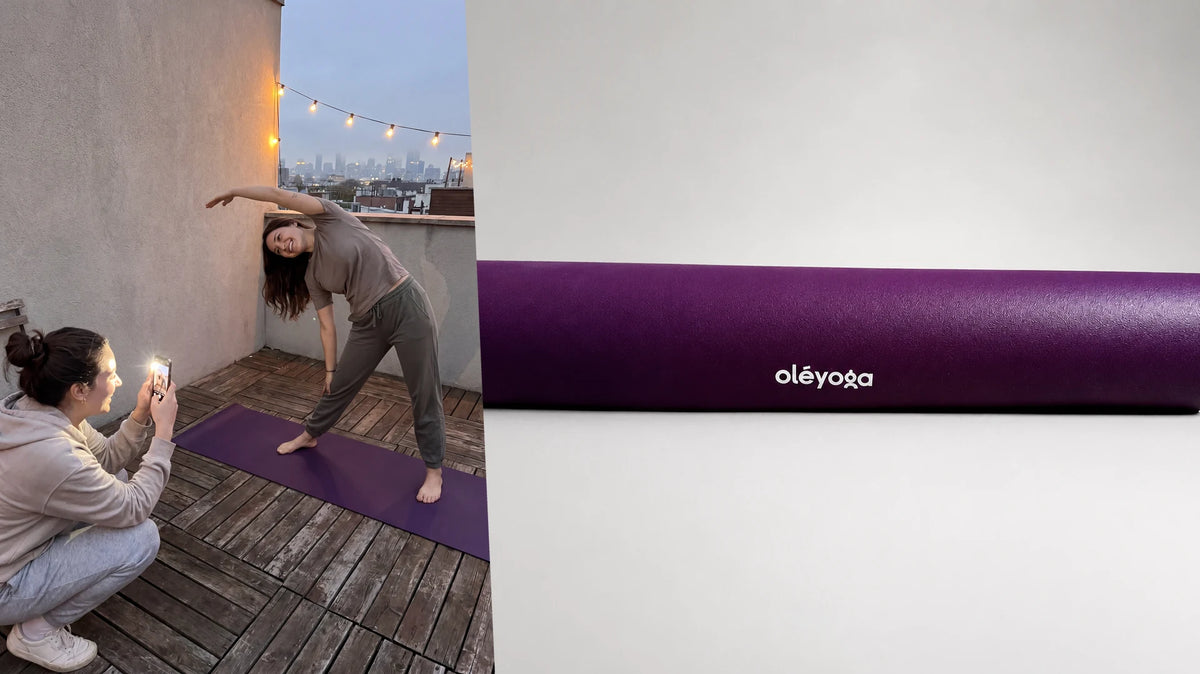

Ashtanga is a fixed, vigorous series practised most days, with jump backs, jump throughs and the same two patches of mat under your hands every morning. You need traction that does not turn into glue, a base that does not sink when you land, and a surface that survives the repetition. Four millimetres of dense natural rubber does that work. A sticky polyurethane top does a different job, and a thick soft mat does a worse one.
The jump back is the test. A mat that welds you in place fails it as surely as one that slides.
What does a Mysore practice actually do to a mat?
It repeats. Primary series puts the hands down in the same places, hundreds of times a week, and the load is not gentle: weight-bearing yoga postures produce substantial ground reaction forces through the palms and feet (measured across twenty-eight hatha postures).
The end of a mat's life in Ashtanga is almost always the same signal: the surface polishes smooth exactly where the hands land. That is friction, not a defect, and it is why durability is an Ashtanga question rather than a general one. More on that timeline in how long a natural rubber yoga mat lasts.
Why do jumpbacks stick on some mats and slide on others?
Jump backs and jump throughs need two contradictory things from the same surface: the hands have to stay, and the feet have to travel. A polyurethane top that feels like glue solves the first and fights the second. Teachers often drill the movement on a hard floor, or with socks, because the mat itself is what gets you stuck.
Natural rubber grips by deforming into the roughness of the skin, not by feeling tacky. Closed cell rubber keeps a high-friction, matte contact without welding you to the spot. That is the difference between traction and stick, and Ashtanga needs the first.
A continuous film of sweat is a different problem: it lubricates rubber contact, which is a classic result on wet rubber friction (Greenwood and Tabor, 1958). Daily Mysore in a warm shala is not the same volume of moisture as a heated class. If your hands are genuinely wet for most of the hour, that is the sweaty-hands question, not the Ashtanga one.
How thick should an Ashtanga mat be?
Around 4 mm, and dense. Thicker mats are sold as kinder on the wrists. What they usually do is let the hand sink and roll, which is extra work for a joint that is already loaded in extension.
| What you feel | What is actually happening |
|---|---|
| Soft 6 mm under the palm | The hand sinks. The wrist has to chase it |
| Dense 4 mm | The hand meets a floor that stops. The wrist stays stacked |
| 1 to 2 mm travel mat | Fine for a day. Unkind for a daily series on a hard floor |
Thickness is how far a mat can compress. Density is whether it stops. Weight per millimetre is the proxy almost nobody publishes: 1.8 kg over 4 mm is dense. 1.2 kg over 6 mm is not.
Is Ashtanga the same problem as hot yoga?
No. A Mysore room gets warm because people work. A hot class is heated on purpose, often past 35 °C, with a continuous film of sweat that closed cell rubber cannot absorb. Ours keeps moisture on top, which is why it wipes clean and why it is the wrong surface in a sauna.
We do not recommend this mat for hot yoga, and a warm Ashtanga shala is not a reason to ignore that line. If most of your practice is heated, a towel over whatever you already own solves more than a new purchase. Daily Ashtanga in an unheated room is the practice this surface is built for.
Who is this mat not for?
The Eco Daily is 4 mm of 100 % natural rubber, 185 × 65 cm, reversible, 1.8 kg, made in Europe, closed cell, certified OEKO-TEX®. That is light for a rubber mat and heavy next to plastic, which is the trade that gives it floor grip.
It is the wrong mat if:
- Your main practice is hot yoga. Closed cell keeps sweat on top. That is a hygiene feature and the wrong property in a heated room.
- You have a diagnosed latex allergy. Natural rubber contains latex. That decision belongs to your allergist, and we set it out in yoga mats and latex allergy.
- You want the feet glued for jump throughs. A sticky polyurethane top will feel more dramatic. It will also fight the movement you are trying to learn.
Common questions
Do I need a longer mat for jump backs?
185 × 65 cm is enough for most people. Extra length helps if you are tall or you consistently land off the back edge. Extra width helps more than people expect, because the hands wander.
Should I practise Ashtanga on a studio mat and keep mine at home?
You can. Shared mats are a hygiene question and a grip question: you do not know what is on them. Taking your own is the point of a 1.8 kg mat that still rolls.
Will the rubber smell in a closed shala?
New natural rubber has a light smell that fades over the first days of use. It is the material, not a coating. Unroll it and practise; it does not need a special ritual.
The short version
Ashtanga wants traction without glue, density without sink, and a surface that lasts the year of repetition. Four millimetres of closed cell natural rubber is built for that daily series. It is not built for a heated room.
More on matching a surface to how you practise in choosing a yoga mat for your style of practice, and style by style in the best yoga mat for every practice. The mat itself is the Eco Daily non-slip natural rubber yoga mat.
______________________
oléyoga makes yoga mats from natural rubber, without plastics, in Europe. One mat, made to be kept. A daily practice lives or dies on the surface, which is why we wrote a guide to non-slip yoga mats.